A Fragile Wonderland
The prairies of the western states and Canadian provinces have a unique lichen community that lives on the soil and rocks of these arid and windswept areas. Similar to the prairies in some ways are the bench lands found in some mountain regions, where the land rises from a river valley to a more or less level area or bench of land between the river valley and the steep mountain slopes. The similarities are open, dry, gravelly and grass covered ground exposed to hot sun and wind and usually extreme temperature variations. Arid soil microbiomes are as essential for a healthy ecosystem as your skin is for your health. Lichens are a critical part of the thin crust on the surface of the ground in all parts of the world, especially deserts, tundra and grasslands. Many bacteria species as well as other microscopic organisms and lichens work together to make a protective coating on the ground that both controls water movement between air and ground and makes nutrients in the soil available to the plants that grow there. Scientists are continually learning more about this previously invisible part of these fragile environments. They now know lichens are a key to the health of all plants and therefor the animals that depend on them.
The rare and endangered desert tortoise in the southwest US deserts was discovered to be declining because the plants it ate had become deficient in several nutrients. The plants were ailing because the surface biome of bacteria and lichen had been disturbed by humans driving vehicles across what was to them barren and useless land. The lichen and cyanobacteria were essential for the plants to be able to use the nutrients in the soil.

It will probably be hundreds of years before the organisms there can rebuild a functioning system in the soil surface.
Many of us have walked on ground that was covered in this living nutrient management system. When you step off a trail onto dry soil and hear a crunchy sound and feel as if you are walking on cornflakes crackling underfoot, you are standing on one of these fragile gardens of tiny organisms. Every step you take destroys years or decades of growth, so please, quickly move back to a bare trail.
When I was growing up near the Wisconsin River, the jack pine forests growing on the sandy river valley soils were filled with lichens. The ground was covered sometimes several inches deep with numerous species of Usnea, Cladonia and other lichens; they hung in long strands from the trees and mixed in profusion with soft pillows of moss scattered through the forests. Now, these forests are gone and the jack pine lands that are left are almost devoid of lichens.
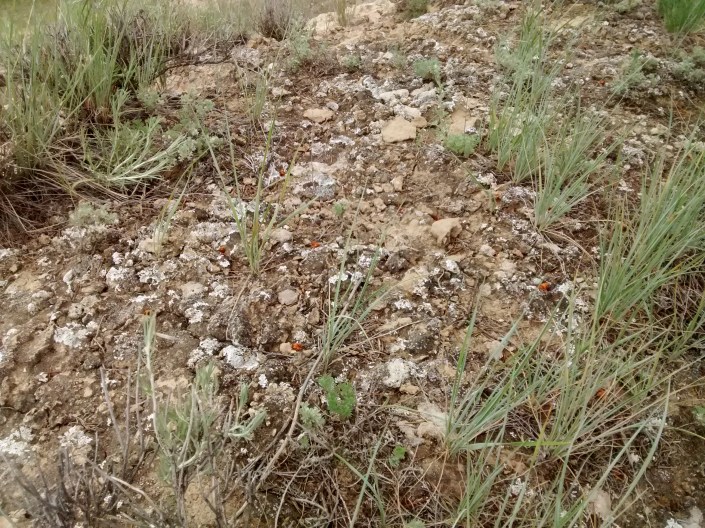
Recently I was lucky to visit a Canadian Nature Conservancy site that had a mostly intact soil biome. The pictures above give an idea of what the ground looks like when covered with these organisms, but this can vary quite a bit from place to place. Even with hiking and bike trails throughout the site, there was a consistent covering of lichens and their companions almost everywhere. The grasslands were being restored by slowly thinning the invading conifers that had come in due to fire suppression.
Grasslands changing to forest would not eliminate lichens and soil biomes, but would gradually change the species that lived there. While walking in the jack pine forest remnants near Lone Rock, I found a few species of cladonia and usnea, some crustose lichens and small areas of ground covered in the fragile mix of moss, lichen, algae, seeds, scat and bacteria that supports root systems, insect lives, water movement and temperature at the interface between air and earth. These tiny areas hold the potential for re-populating the surrounding land. We can help restore this fragile yet essential web of life first by being aware of the surface of the earth as you travel on the land, on foot or in a vehicle as much as you are aware of the trees, flowers, animals, water or sky. Then, stay on trails. So many humans now move through the landscape that anywhere we travel there are significant consequences for all the creatures and plants that live there. Stay on trails, leave room for the needs of those who live where you visit. Tiny burrows that are homes to many, scent trails, access to food and water at the times the residents need them, unrestricted movement to stay safe from predators and conversely, for predators to have normal hunting opportunities are all essential for survival for those who live where we travel. And not least, because it is a fundamental part of the Web of Life, is an undisturbed biocrust.
Stay on the trails, but stop and look frequently at the ground. Take out your hand lens, get down close and look. There is as much or more going on at the surface of the ground as there is in the forest or marsh or field above.
How many lichen do you see on the soil? On the rocks? Which rocks have many lichens, which have none? Can you tell the difference between some of those tiny crustose lichens and an algae? Are insects there? Burrows of reptiles or mammals or insects?
Looking for lichens leads into layers of the living world we do not usually pay attention to. Don’t miss out on where most of the life and action is, slow down, look down, magnify, take a picture. Lichens are busy there, making food, shelter, medicine for everyone. Step on the trail, not on the lichens!

 KVR Lichens