Author: lichenhunter
Beatrix Potter – Mycologist and Lichen Researcher
Beatrix Potter, Mycologist: The Beloved Children’s Book Author’s Little-Known Scientific Studies and Illustrations of Mushrooms

Excerpt from Maria Popova, Brain Pickings:
By her early twenties, Potter had developed a keen interest in mycology and began producing incredibly beautiful drawings of fungi, collecting mushroom specimens herself and mounting them for careful observation under the microscope. In the winter months, she frequented London’s Natural History Museum to study their displays. Linda Lear, author of Beatrix Potter: A Life in Nature writes:
“Beatrix’s interest in drawing and painting mushrooms, or fungi, began as a passion for painting beautiful specimens wherever she found them. She never saw art and science as mutually exclusive activities, but recorded what she saw in nature primarily to evoke an aesthetic response. She was drawn to fungi first by their ephemeral fairy qualities and then by the variety of their shape and colour and the challenge they posed to watercolour techniques. Unlike insects or shells or even fossils, fungi also guaranteed an autumn foray into fields and forests, where she could go in her pony cart without being encumbered by family or heavy equipment.”
 There is also something quite poetic about Potter’s obsession with fungi — in her later children’s books, she bridged real life and fantasy by transmuting the animals and plants she observed in nature into whimsical characters and stories, and mushrooms have long symbolized this very transmutation, perhaps most prominently in Lewis Carroll’s Wonderland, which first captured the popular imagination the year Potter was born.
But her interest went far beyond the mere aesthetics or symbolism of mushrooms — she was studious about their taxonomy, taught herself the proper technique for accurate botanical illustration, and worked tirelessly to get an introduction to the eminent mycologist Charles McIntosh. With his help and encouragement, she continued advancing her microscopic observations, which kindled in her an intense fascination with how mushrooms reproduced — something poorly understood at the time. Potter soon began conducting her own experiments with spores she had germinated herself. She was particularly captivated by lichens, considered at the time the “poor peasants of the plant world,” in the words of the great botanist Linnaeus — a statement itself belying the dearth of scientific understanding at the time, for lichens are not plants but a hybrid of fungi and algae. more
Share this:

New Resources for the KVR Lichen Project

The KVR Lichen Project now has a copy of ‘Lichens of North America’ at the Visitor Center reference library. This is a book to get lost in. It is comprehensive, with beautiful images and extensive identification information. If you find a lichen, it will probably be in this book. When you find a lichen, take a few good photos, remember to peak underneath if the lichen is a foliose or fruticose structure, then sit down with this book and see what you can learn. And while enjoying the book, consider joining the Friends of the KVR.
I’d like to thank the Friends of the KVR for their generous grant to the Lichen Project, for the purchase of this book and other materials. The Friends of the KVR supports and funds many projects at the Reserve. They also spend countless hours volunteering at events throughout the year. Check out how your participation in the Friends of the KVR can help our very special Kickapoo Valley Reserve.
The Lichen Project now has a Celestron digital microscope, hand lenses, a black light flashlight, and several reference books. A special addition this month is the new booklet ‘Common Lichens of Wisconsin’ written by James P. Bennett and published by the Wisconsin State Herbarium. This is very useful to carry on your hikes for quickly looking up some of the common lichens in our area. Thank you Dr. Bennett for this booklet.
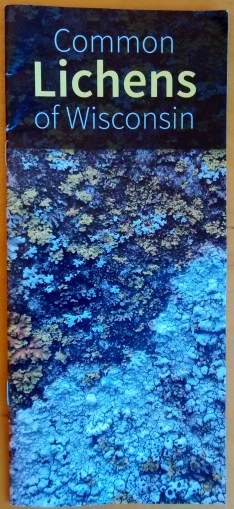
Now, i’m off to the woods to look at lichens. After all the wet weather lately, the lichens, moss and fungi are growing and blooming.
Share this:

Likin’ Lichens at the Kickapoo Valley Reserve
The spring Lichen Hunting Season will get started Wednesday March 29th at the Nuzum Talk at the KVR Visitor Center. Come on out and have a conversation about lichens with me! You can have a snack and relax with friends and see and learn about a hidden world.
Learn how to enter and explore this magical, hidden world. Visit with your friends, enjoy a snack, and find out about the KVR Lichen Project. We have a wonderful new microscope that will be set up for you to look at lichens up close, where lichens show off their beautiful structures and colors.

Meanwhile, the damp weather is great for lichens. They are very active now and colors are bright and easily seen. Look around at the trees nearby. The bright green and blues and white are all lichens that have gone from dormant and dry to moist and actively growing, photosynthesizing and reproducing. It’s the best time to look closely. Use a small hand lens if you have one. As little as 10x magnification brings a completely different view of what a lichen looks like. Remember to look for lichens on rocks and even undisturbed soil.
See you Wednesday, at the Kickapoo Valley Reserve!

Share this:

Lichens and Country Music
Many lichen cannot be named unless they are observed when in a fertile state. One common crustose lichen in the Appalachian region has been observed for many years but never seen reproducing. That changed when a large number of fertile lichen were found on the top of Hangover Mountain in western North Carolina. They were common in many areas but this was the first time anyone had seen them in a fertile state. These lichen were then named….for Dolly Parton. Japewiella dollypartoniana now had a formal name and characteristics to identify it in the future.
Jessica L. Allen and James C. Lendemer, who made the discovery and published their findings in 2015, described the lichen as “….distinguished from other species of Japewia and Japewiella by its sorediate thallus and production of norstictic acid….”. There is more technical description of the lichen that follows.


Japewiella dollypartoniana is described as new to science based on material from the Appalachian Mountains and adjacent regions of the Atlantic Coastal Plain. It is distinguished from other species of Japewia and Japewiella by its sorediate thallus and production of norstictic acid. Placement in Japewiella is supported by characters from fertile populations discovered in the Unicoi Mountains of western North Carolina which have apothecia that resemble those of Japewia tornoënsis (Nyl.) Tønsberg but differ in having a well-developed proper exciple and ascospores without a thick, gelatinous sheath.
Share this:

Building with Lichens
Did you know that many, maybe most lichens have some antibiotic properties? Animals and birds know this and eat or use lichens in various ways that may help them stay healthy. One common use of lichens is as a construction material in bird nests. The lichens may help keep baby birds disease free. Many birds use lichens, so look for nests especially when the leaves fall off the trees in autumn and nests are easier to find, and notice how many may have some lichens incorporated. If you can figure out what species of bird made the nest, that’s even better. Please let the Lichen Hunters know of your find.
It is not for us to know all the reasons a blue -gray gnatcatcher builds its home with lichens, but I can think of several possible reasons. Of course one reason is the known antibiotic property of the lichen; a built in disinfectant, in the walls of this perfect little home! Another reason may be that lichens are beautiful; the lovely blue-gray color the gnatcatcher likes in the lichens can be found in elegant home decor magazines, for human homes. Maybe the blue-gray gnatcatcher is matching its own color by using the same color of lichen on its nest walls, as we would wear harmonious colors because they are pleasing to see. Another reason may be that the flat surface of the foliose lichen may be somewhat water resistant and makes a nice solid surface. Also, since the lichens grow on the tree branches, covering the nest with the same lichen is good camouflage, hiding the chicks who would be a tasty treat for many predators, as well as the adult birds when they are resting on the nest.
Years ago I found a hummingbird nest made of lichens, in an apple tree. The nest was the size of a thimble. I considered it a small miracle that branch appeared right in front of me while picking apples.
This lovely photograph is from Paul and Bernadette Hayes. They recently found the nest about 10 feet up in a box elder tree, on a horizontal branch. It is the home of a bluegray gnatcatcher. Thank you Paul and Bernadette.
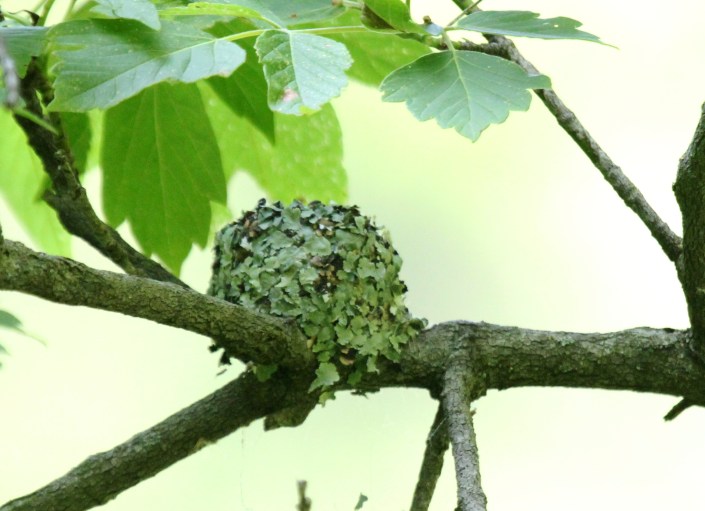
Discovering a well made birds nest covered in lichen is a lucky find. Please share your discoveries so we can learn about the birds in our home territory that use lichens.
Share this:

Mycorrhizal Fungus: Lichen’s Cousins
We may be hearing a lot more in the future about mycorrhizal fungus. This site is an ongoing story about lichen, and officially, mycorrhizal fungi are not really ‘cousins’ of lichens. But cousins are often the most numerous relatives we have, so I use that term to foster awareness that the fungus Kingdom is varied and vast. Sometimes getting to know one member of a family entails getting to know other members of the family one had not planned on meeting, or even knew existed. At the party called Daily Life on Earth, meeting all the relatives is part of the fun.
I met a mycorrhizal fungus last fall, on a dead tree trunk at the end of the Wintergreen Trail. I believe it is hyphae but do not know the fungus species. If anyone reading this knows, please post your ideas! Even deceased, it was an impressive presence. Long dark threads hung from the leaning tree trunk where the dry bark had separated from the inner wood. The threads formed a complex web several feet long, dangling in the air. The strands were so strong I could not break them by hand. There was yards and yards of this fibrous material. It seemed to have covered most of the surface of the tree trunk, under the bark.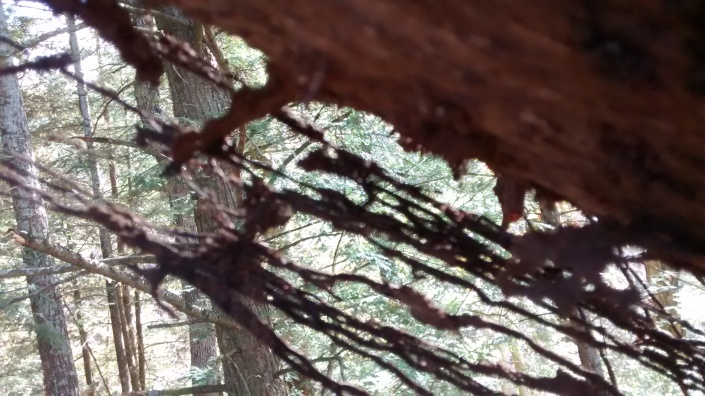
Fiber strings from under tree bark
The picture is blurry, but the very dark strings and dark bark had no noticeable detail, so the picture is close to what I saw. The extent of the fiber mass was impressive.
Why am I talking about this mat of dark threads? Because I was exploring the NASA Global Climate Change site and found a story on mapping the mycorrhizae locations in forests, by mycorrhizae species. Read the story for why NASA is doing this; it’s interesting. There are two mycorrhizal species and trees use one or the other. The forests are regulated by the signals the mycorrhizae send through the trees. They work with other plants too. Scientists think this is important enough to make maps of where each species is in the forest, in relation to the tree species, and they are doing so by satellite images. So that old adage “you can’t see the forest for the trees” is true for us in a much deeper way than we ever understood before. The trees are one part of a vast and complex web of living beings, all talking to each other and cooperating to regulate themselves and their environment. Once we lift the curtain of our preconceptions, amazing things start to show up everywhere. If we only see trees, birds and some flowers, we are missing the major part of the forest. There is far more diversity and number of living beings in and under the soil than above it, and as much metabolic function occurs on and in the ground as above. The Small Ones may be at least as interesting as the large plants and animals we easily recognize.
After reading the article and thinking again about the mycorrhizae, I wonder about the relationships between fungus that don’t make lichen and those that do; between the chemistry created by one group of trees and fungus, and the signals of moisture, temperature, nutrients and more that may be allowing or encouraging certain other living beings to take up residence nearby. We know so little about the extensive activity going on just underground. What similar actions may the lichen be doing? After bacteria, they are the original homesteaders, setting up the terrain to be hospitable to the first mosses and vascular plants. Lichen are very good at getting along with other life forms and have made a place for themselves everywhere on earth. Maybe they have something to tell us about their part in regulating the forest, beyond their original activity of creating soil and available nutrients from rock and wood and air.
So, no lichen pictures today, just questions about this green and shining world we share with unknown others.
Check this blog again soon, for information on our first KVR lichen survey route.
Share this:

Lichens from Florida

Cladonia evansii
This gorgeous lichen was found by Julie Hoel in St. George Island State Park, off the panhandle of Florida, late this winter. It is growing in a slash pine forest, on sandy ground. Thanks Julie for sharing this.
We don’t see this lichen in the Kickapoo, but I remember similar lichen in the jack pine forests of the Wisconsin River valley when I was a child. The oak and jack pine forests from Mazomanie, Arena, Spring Green, and Lone Rock area were filled with mosses and lichens. The ground was covered and they hung on tree branches. It was a wonderland of shapes and colors. As a child I knew it was a magical place and I spent many hours there but had no way to know what I was seeing. Now those forests are mostly gone, covered with irrigated, industrial scale, sprayed crops. The lichen are in retreat and mostly absent. With them went the diversity of birds, amphibians and plants that made up that fragile and beautiful land. In those days only a child would recognize the beauty in that dry, unassuming landscape but now some of the goat prairies and grasslands are being restored, and there are remnants of sandy jack pine forests in the river valley.
Julie’s Florida lichen picture inspires me to explore some of the Wisconsin River valley forests that are left to search for my lichen and moss friends from years ago.
I’ll let you know what I find!
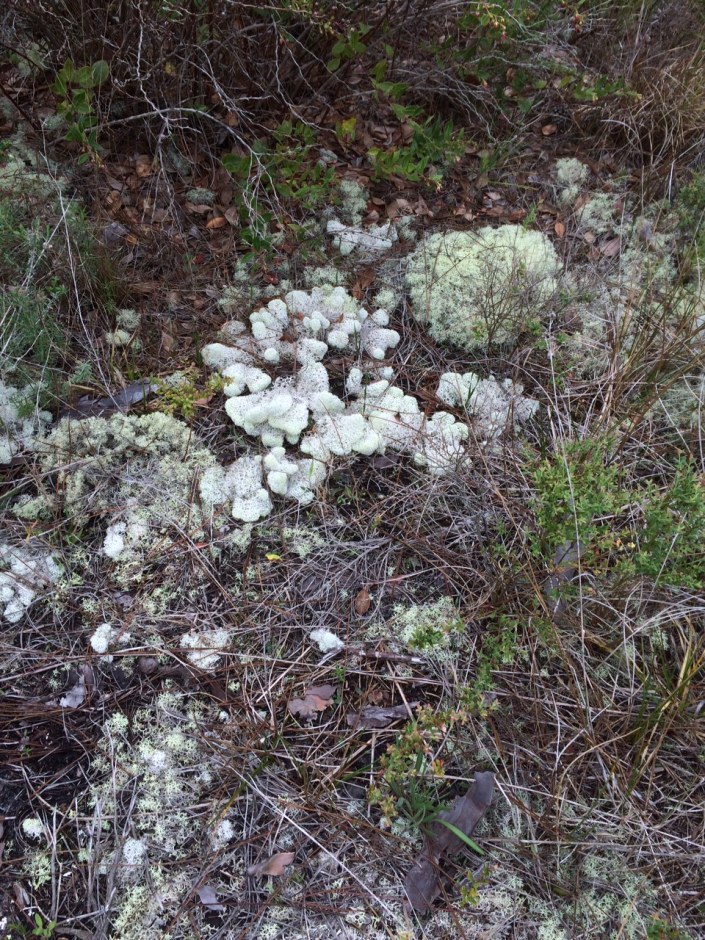 Cladonia evansii with its friends, the mosses
photo by Julie Hoel
Share this:

‘lichen’ it from afar

I have had the great fortune to be travelling in Australia since early December. In the midst of visiting friends and family I have also been in search of lichens.

Discovering lichens on a rusty steel hull of a 100 year old gold digging machine in a dried up river bed has been the greatest surprise to me.

The most noticeable difference from lichens at Kickapoo Valley Reserve has been the extreme absence of tree lichens in many areas. While considering this, it clicked that over half of the trees in Australia being eucalyptus and melaluca all decortify every year (lose their bark). Lichens being slow growing communities are not so partial to growing on constantly changing strata.
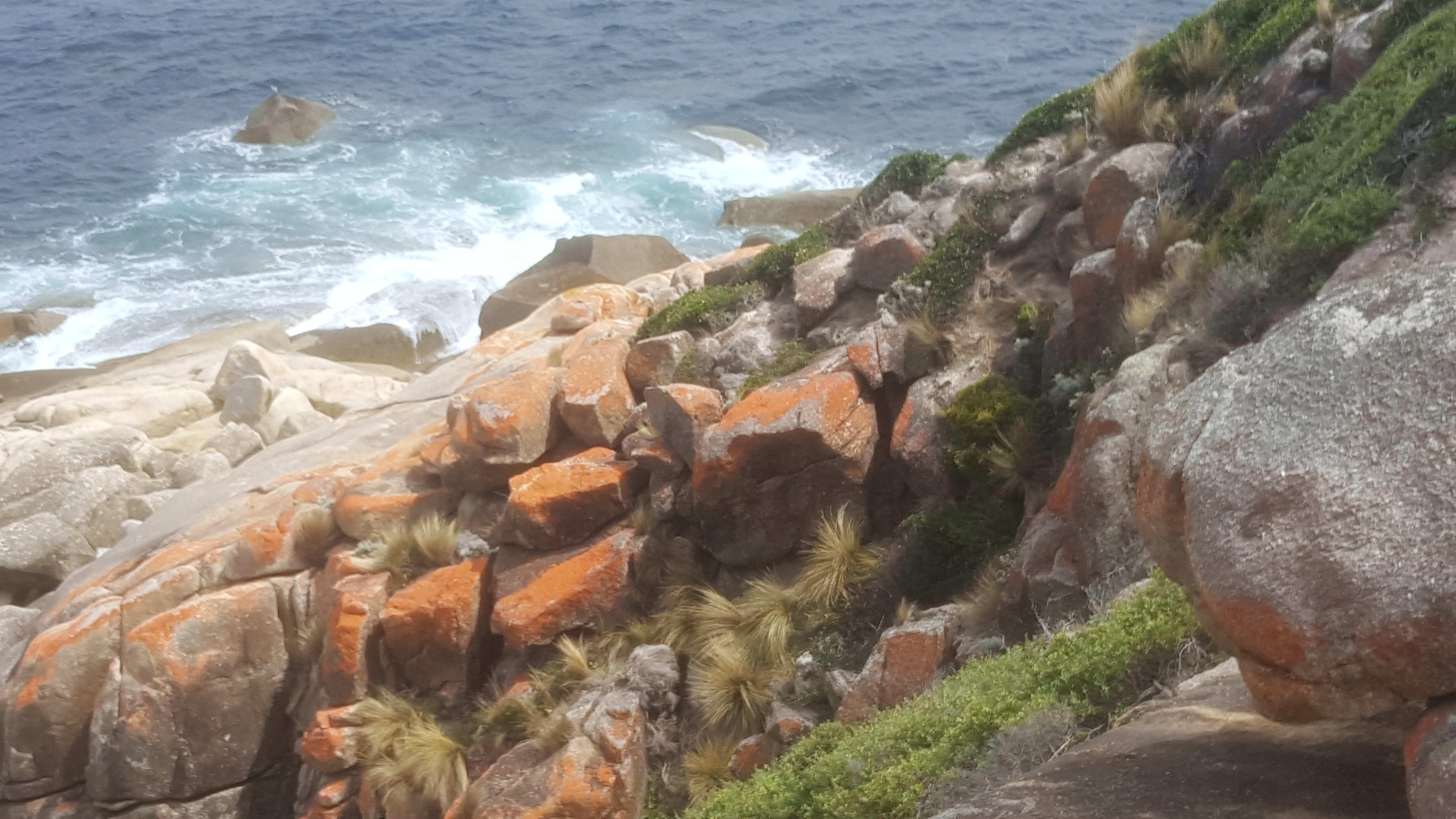
I was sure I would find many in the damp sub-tropical forests, and farmlands, but was really surprised to discover them in what I would have considered inhospitable locations: dry river beds with dead trees and running rampant across boulders washed by ocean tides and blasted by hot sun. Some of these locations have been in drought for over 7 years. Seasides, bereft of most plant life and old tombstones in dry country graveyards, were populated with many different communities of lichens. I do not know many of their names, but it has been a delight to discover their adaptability.
The colors are quite spectacular, particularly in the moist warm areas of the eastern coast.


Paying attention to lichens on this journey to Australia has added a new dimension to my journey, as I not only witness the drama of this landscape in its large breathtaking vistas, but also able to recognize the miniaturized vistas and complexities of lichen communities in very diverse landscapes.

It is a new depth of exploration and has expanded my vision of forests, seascapes, and dry farms and eucalypt forests.
I wonder what lichens exist in the dry moonscape of Cooper Pedy or the towering red rock of Uluru and the Olgas all places I had the opportunity to travel to in the past, but did not know enough to seek them out.
Im “lichen” these lichens as they are adding a new dimension to my journey.
submitted by mary lou
Share this:

Winter Lichens 3
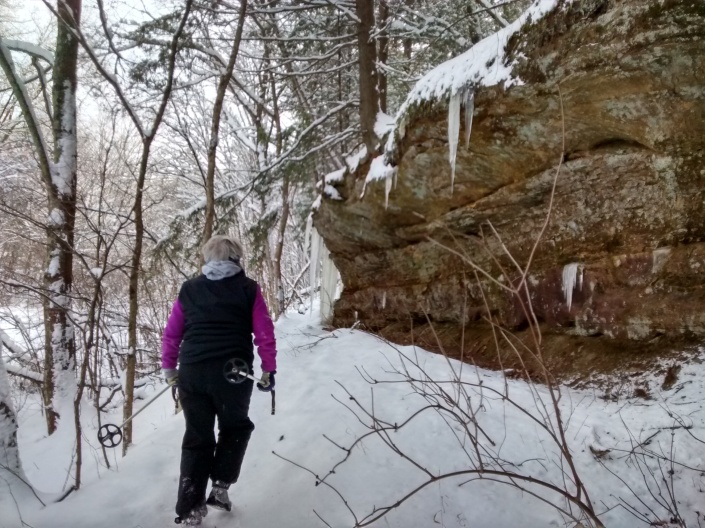
Julie, Olga and I went out to view the white and wonderful woods after the big snow a couple days ago, and I, of course, had a secret agenda to also check on the Little Ones. As soon as the new snow warmed slightly the snow fleas were out hopping around. I knew the lichen would not be hopping around! But they do show their colors in the snow and I am still searching for new species. Each day in the forest brings the possibility of meeting a new lichen (as well as whatever other wonders appear whenever one stays in the woods a while). We are walking on Cutoff Trail. The ice has formed curtains along the rock walls, as it has almost everywhere this year.
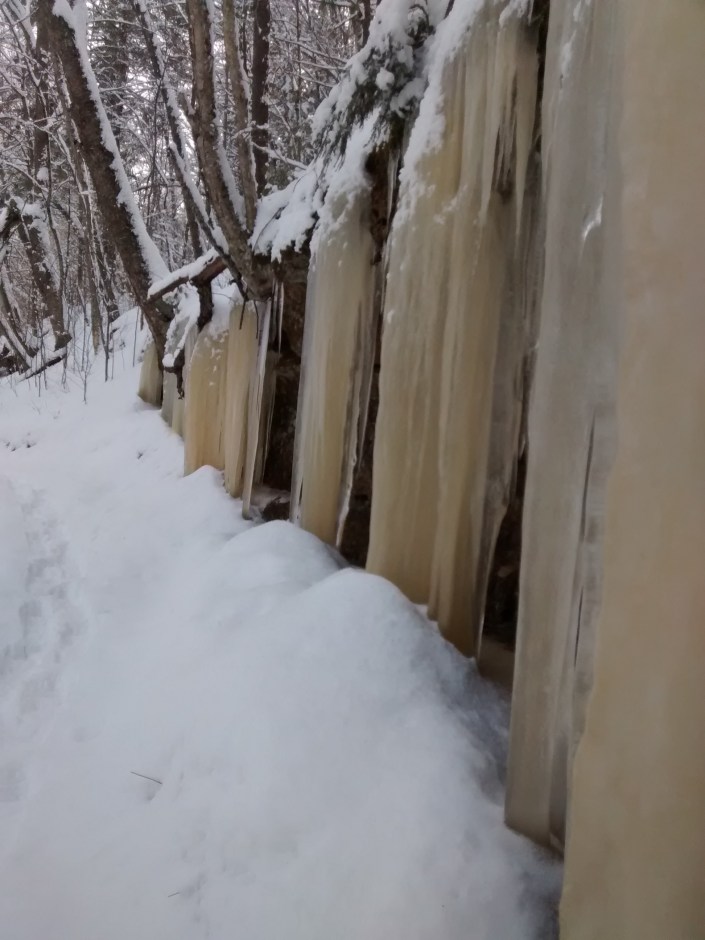
No ice caves here, just a small cliff. The rock is mostly covered with liverwort, moss, fern; the lichen are small. One of my favorite trees, the river birch with its beautiful coppery bark, stands here.
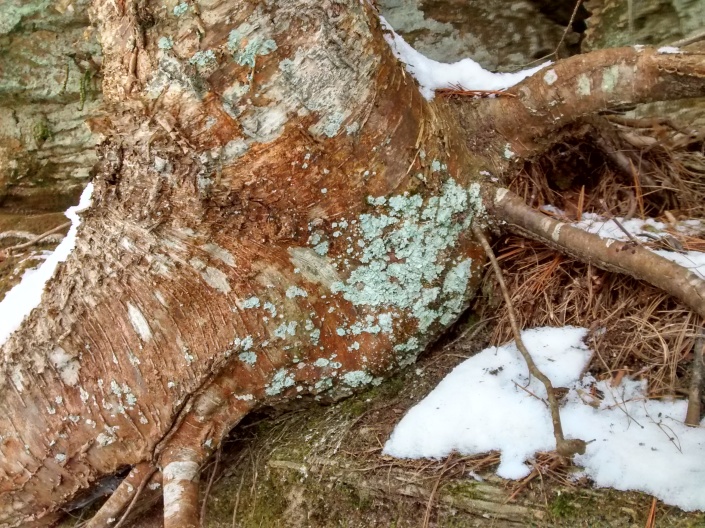
The lichen like this tree too; the moist base has a colony of aqua blue lichen. Aren’t they beautiful on the red and silver bark? Since the names are not verified yet, I can describe them any way I wish, in this blog anyway! Don’t worry, names will be forthcoming by spring.
Turkeys flapped around in the treetops. The sun came out. On the south slope, snow in the branches began to melt, just enough to form liquid water at the edges of the snow on each branch. The trees were suddenly illuminated in diamonds of light. A few moments later as we walked away from the direct sunshine, the warming air simply made the clumps of snow in the branches fall off on our heads.
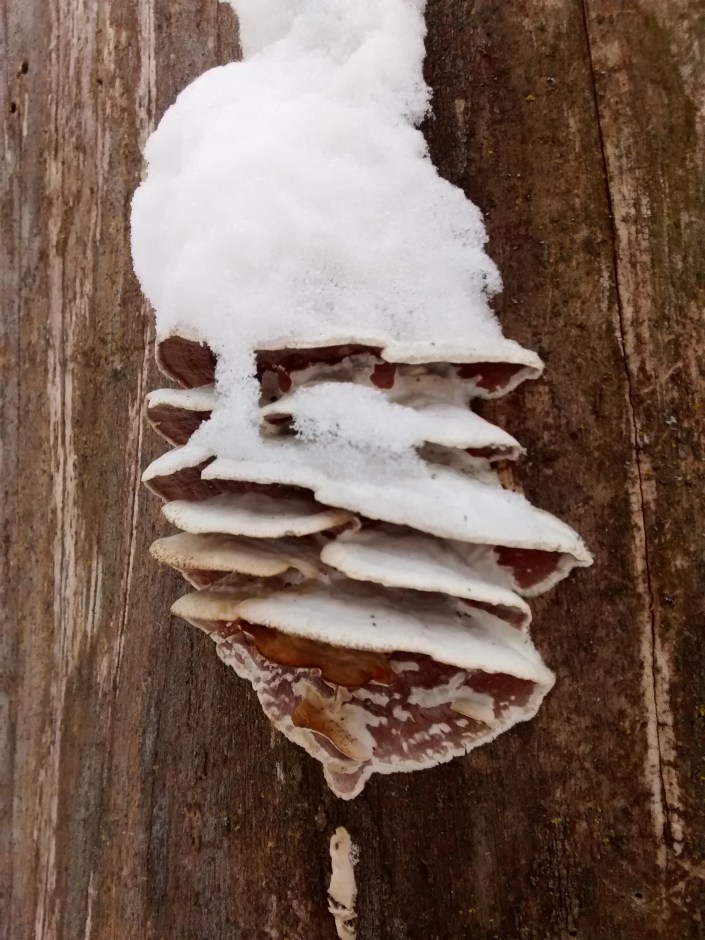
This is not a lichen, it is a fungus, making a little snow sculpture on the side of a tree.
While we move about so quickly and ceaselessly, the trees, moss, rocks and lichen quietly remain. The ice moves too. More slowly than us but faster than lichen, rock or tree; changing all those slow moving ones as it forms, grows and then disappears. The lichen and their rocks and trees will be here as we and the ice come and go. 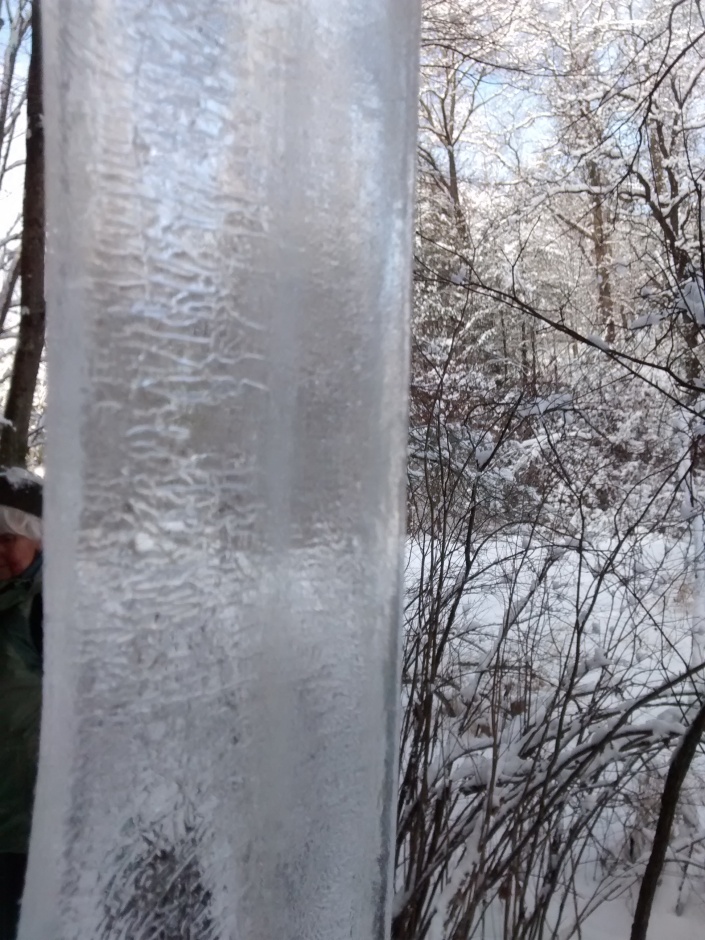
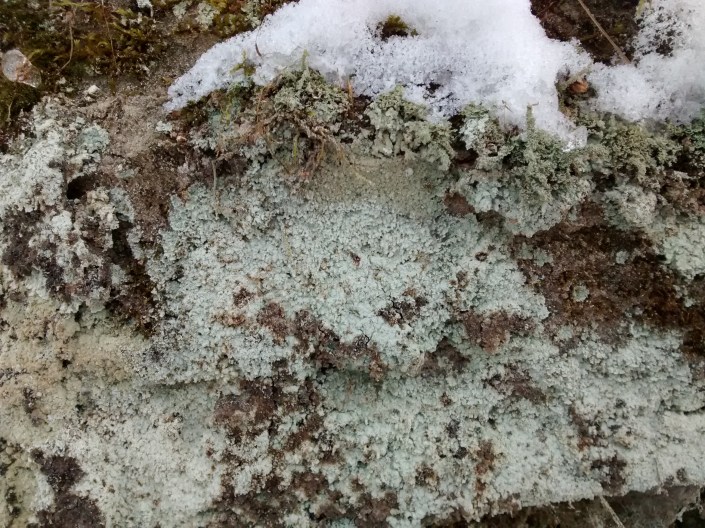
Remember to enjoy the small things in life.
Share this:

Winter Lichens Part 2
Remember this, from a week ago? A little frosty but still green and growing.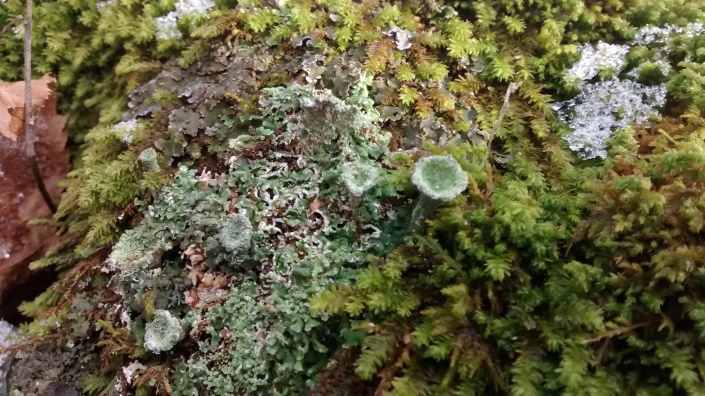
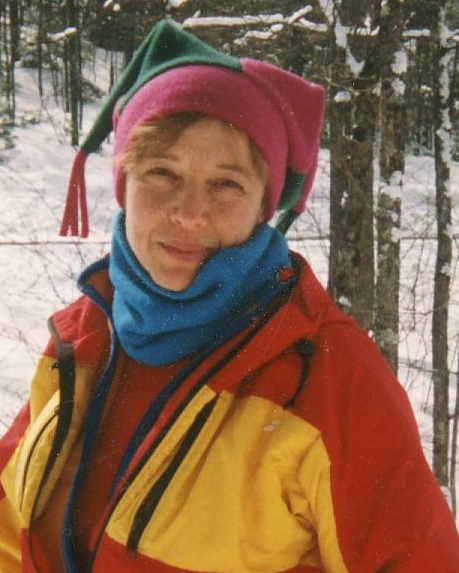
Today, January 10th, it was 5 degrees above zero and this is my lichen hunting outfit; every layer of Canadian ski clothes I can find:
And here’s Lichen Land now:
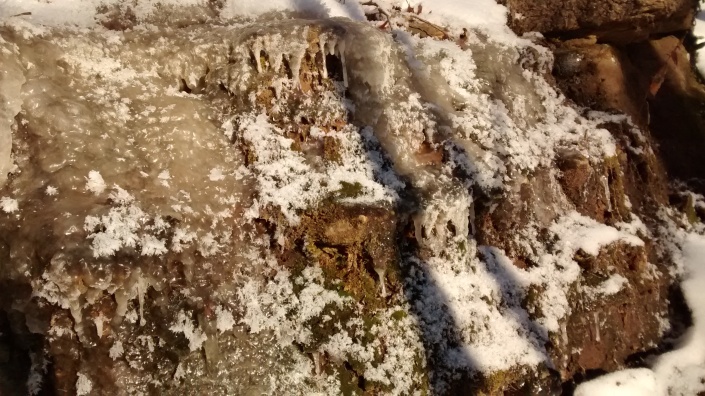
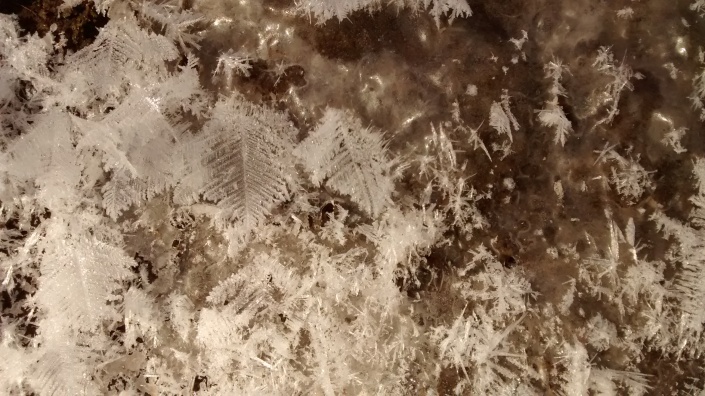
But as we know, the lichen are quietly waiting for the ice to melt. Meanwhile the ice is busy make beautiful patterns. I wonder what it looks like from underneath, where the lichens are?
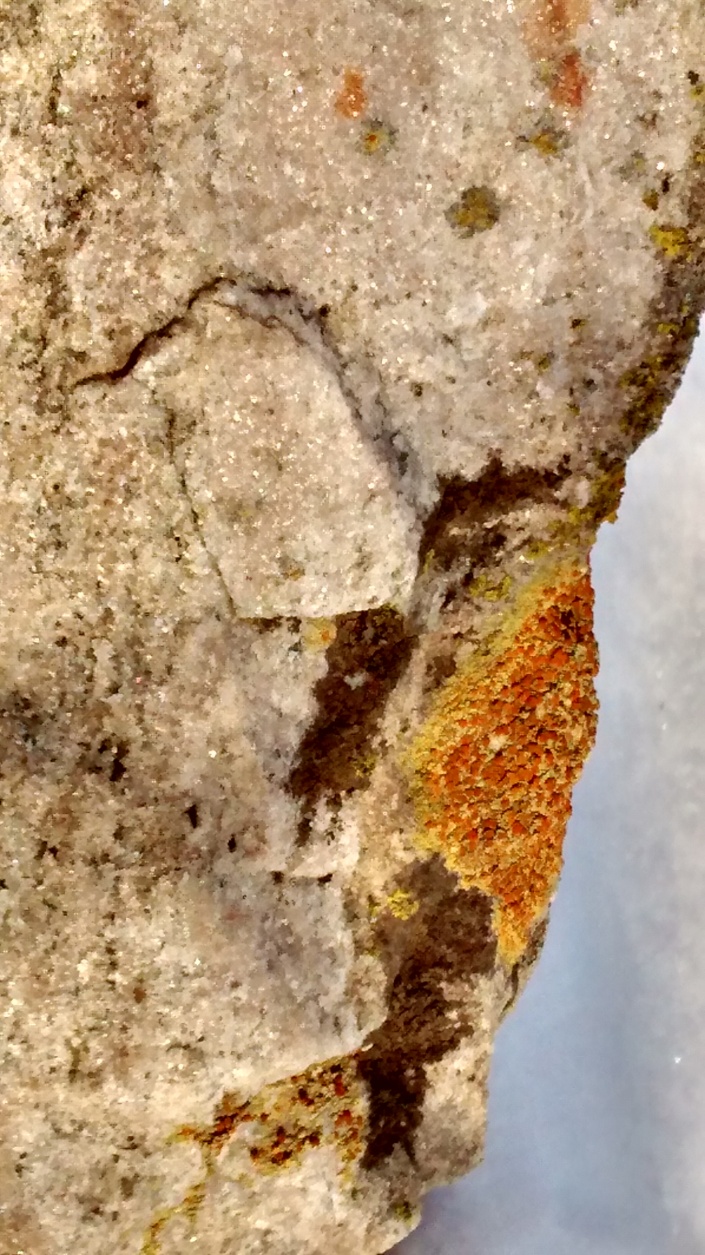
Since it was so cold today, I went out to see what the lichens looked like on the hill behind our house. As I searched for them in the ice and snow I thought about how quickly they exchange their active life for dormancy. Another warm day and these ice covered lichen will be back to life in a few hours.
Below: very cold lichen
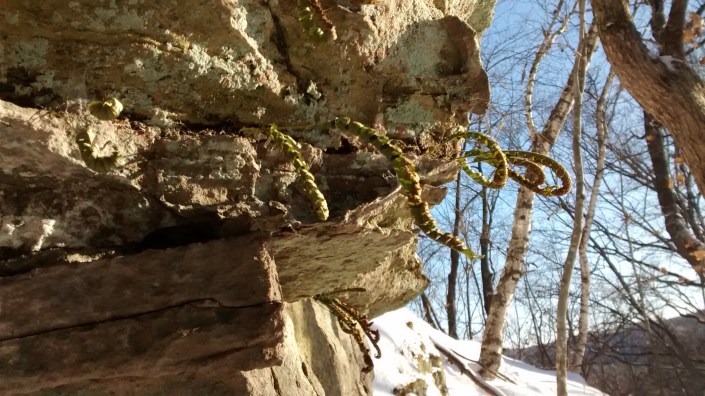
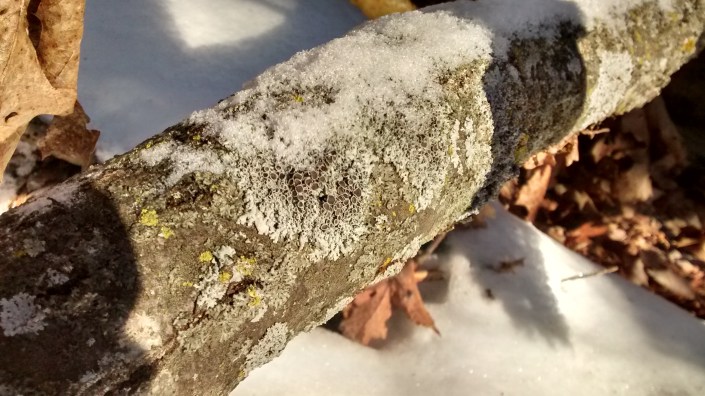
It’s fun to see what else is out in the woods besides the lichen.
This is the hilltop where these pictures were taken:
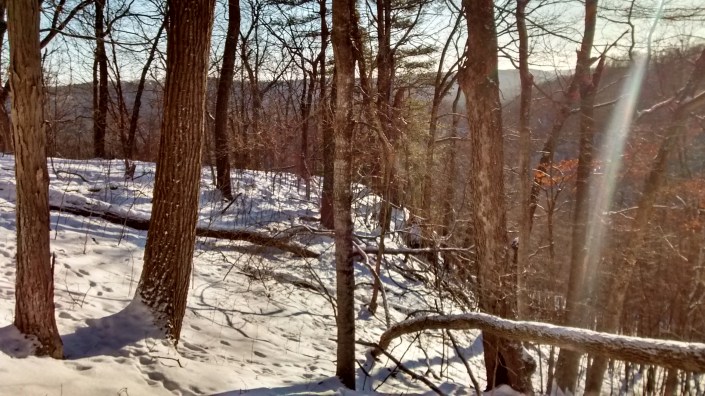
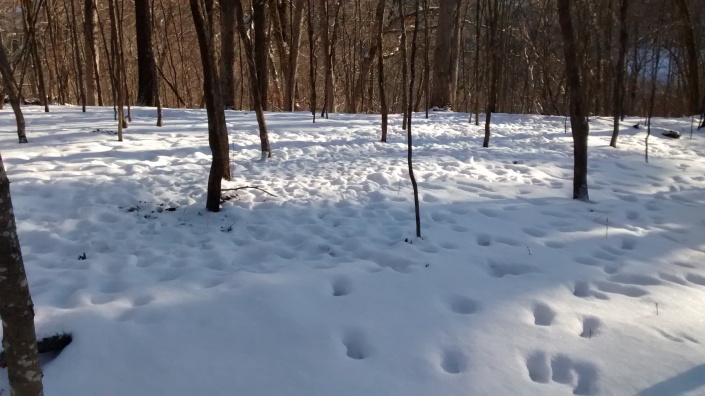
It’s a busy place. See all the tracks? Our coyote friends like to gather in this area and sing to us. Their tracks tell the story of what they do while here.
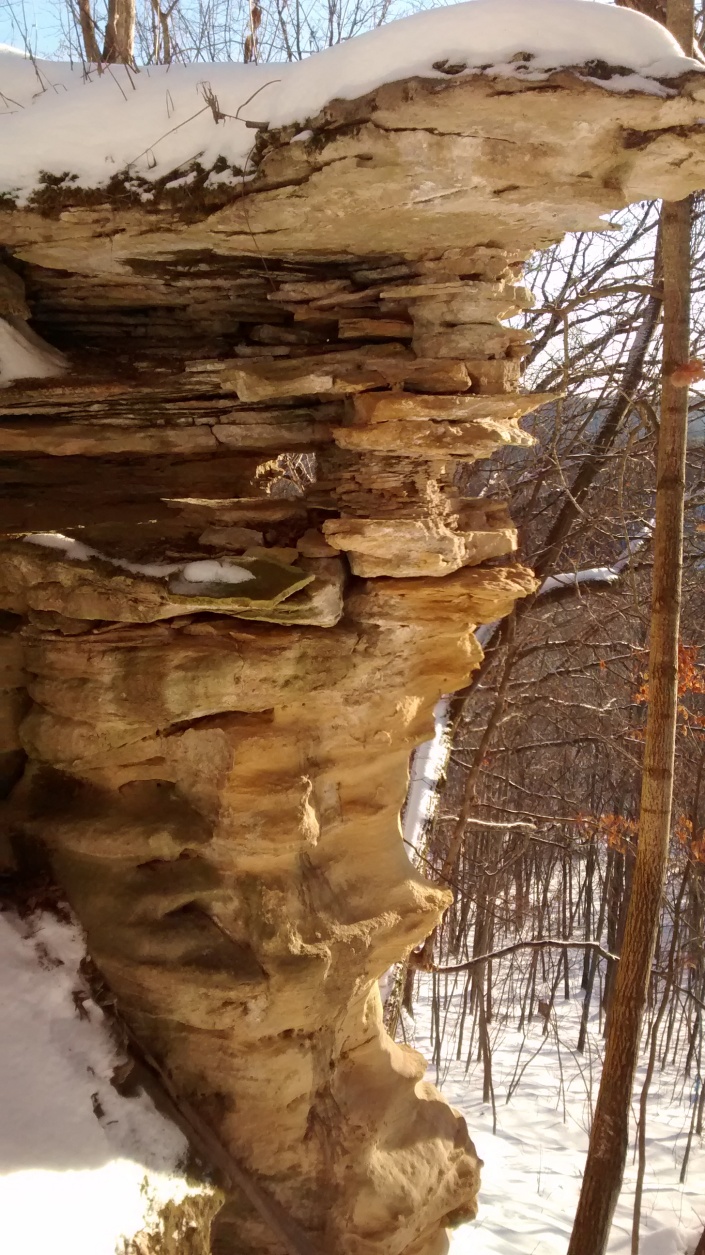
Sandstone catching the afternoon light
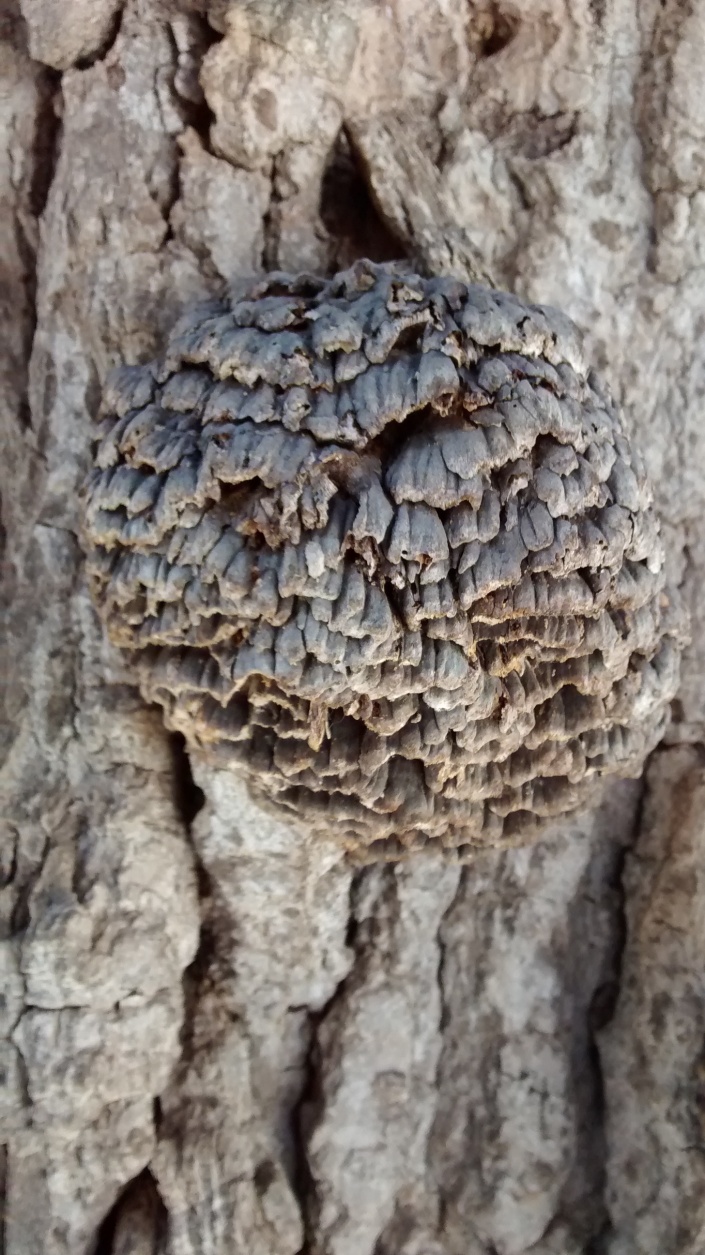
At the top of the ridge a dead tree trunk supported these fungus
After an hour there seemed to be more and more snow and less lichens, and it was getting colder so I went home. I went less than a quarter mile from the house and had a good adventure. What’s close to home where you live? If you’re out there and meet your own resident lichens, share them with us!

 KVR Lichens